
More than 20 overlooked First World War victims to be named on Newton Abbot War Memorial
More than 20 overlooked First World War victims to be named on Newton Abbot War Memorial
DECADES of research by a volunteer at Newton Abbot Museum has revealed the identities of 21 First World War victims who were overlooked when the town’s War Memorial was commissioned more than a century ago.
John Ellis, a retired civilian senior administrator within Devon and Cornwall Constabulary, spent thousands of hours trawling through archives, newspaper cuttings, official documents and public notices to discover that 21 local men whose deaths could be attributed to the 1914 - 1918 conflict had never been officially honoured.
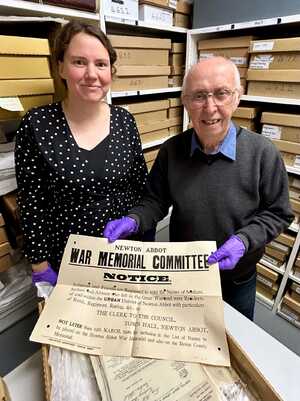
One of the main reasons they were missed was the paltry fortnight’s notice given to grieving relatives in 1920 for them to submit their nominations.
It’s an oversight John has now brought to the attention of Newton Abbot Town Council where plans are under way to finally give the fallen heroes the recognition they deserve.
‘I’ve always been interested in the history of Newton Abbot and for my sins I was in St John Ambulance for a large part of my life,’ said John, who joined the museum in 2011 and whose early research resulted in the 2014 publication of his book, Newton Abbot’s Great War, Forgotten Times - Forgotten Men.
‘In 1995 the local St. John Division celebrated its centenary and I started to write a history and realised that from 1914 - 19 they ran the Newton Abbot Voluntary Aid Detachment (VAD) Hospital, an auxiliary hospital treating casualties from the front.
‘Only three soldiers died in the hospital but that drew me to the war memorial and the men from Newton who had fallen in that war.
‘Now, I have plenty of local history books, but even in the best of them the First World War was just granted coverage of a paragraph or two and I thought this was an oversight.
‘So I undertook the task of transcribing everything related to the conduct of the war from the two local newspapers from 1914 - 1920 and subsequently to track down the last resting place of the 232 men on the memorial.
‘That ended up with over 1,400 pages of my typed notes and it was going through those that I picked up a lot of names of men who weren’t on the memorial.’
In 1999 John made his first trip to Western Front, that stretched the 475-miles from the North Sea to the Swiss Border, his long-term aim to start visiting the graves of Newton’s fallen men.
It’s a journey he’s made almost every year since, visiting more than 120 cemeteries and each time placing a Remembrance Cross complete with the handwritten endorsement ‘From a Fellow Newtonian’.
These are mainly donated by the Newton Abbot branch of Royal British Legion.
With his research about to bear fruit in the shape of the missing names being added to the memorial, John said: ‘I’m born and bred in Newton Abbot, proud of what the town has achieved, and I just think this is an omission which is time we put right.
‘I know a member of one of the families and have been in contact to say what’s happening and she was very pleased, keen that I keep in touch.
‘These were not just names, these were people, the youngest being Bugler Charles Symons of the 1st/5th Devons who was just 17 when he died of dysentery in Egypt.
‘Another man was 32-year-old Private Frederick Tucker of the 1st Devons who, as a child, had lived in the Newton Abbot Union Workhouse, gone on to become a farm labourer and, unfortunately, a prisoner in Devizes Gaol.
‘His subsequent Army four-figure service number indicated he could have joined up as a regular soldier on release from prison and was later awarded the trio of medals including the 1914 star indicating he was at the front, and died there in November in 1914.
‘Any debt he owed society as a result of his criminal behaviour was surely settled in full when he paid the supreme sacrifice at the very start of the war.’
One more name from the list is that of Linotype operator Sgt Charles Smith, a native of Newton Abbot.
Born in 1886, he emigrated to Australia and enlisted in its Infantry Force in September 1916.
He was wounded in action on May 15 1917 and sent back to the UK from Belgium to recuperate.
A few months later he returned to the front, only to be killed in action shortly afterwards.
‘I shall feel relieved when I see the names on a plaque, relieved that these men have finally got the recognition they deserve,’ said John.
‘It means a lot to me. No-one can understand their experience in reality, but I understand a lot of the conditions and the trauma they went through.
‘It’s time we recognised that.’
Museum Curator Joanna Eccles said: ‘John’s exhaustive research is to be applauded and his town should be proud of him.
‘He has corrected a century’s oversight and we look forward to seeing the additional 21 names put in their rightful place on the memorial.’
Photo shows John Ellis and Joanna Eccles with the 1920 public notice that gave grieving families just two weeks to make their nominations to have names included on the memorial.
Posted by Carla Winsborrow on October 9th 2026
 Updating page...